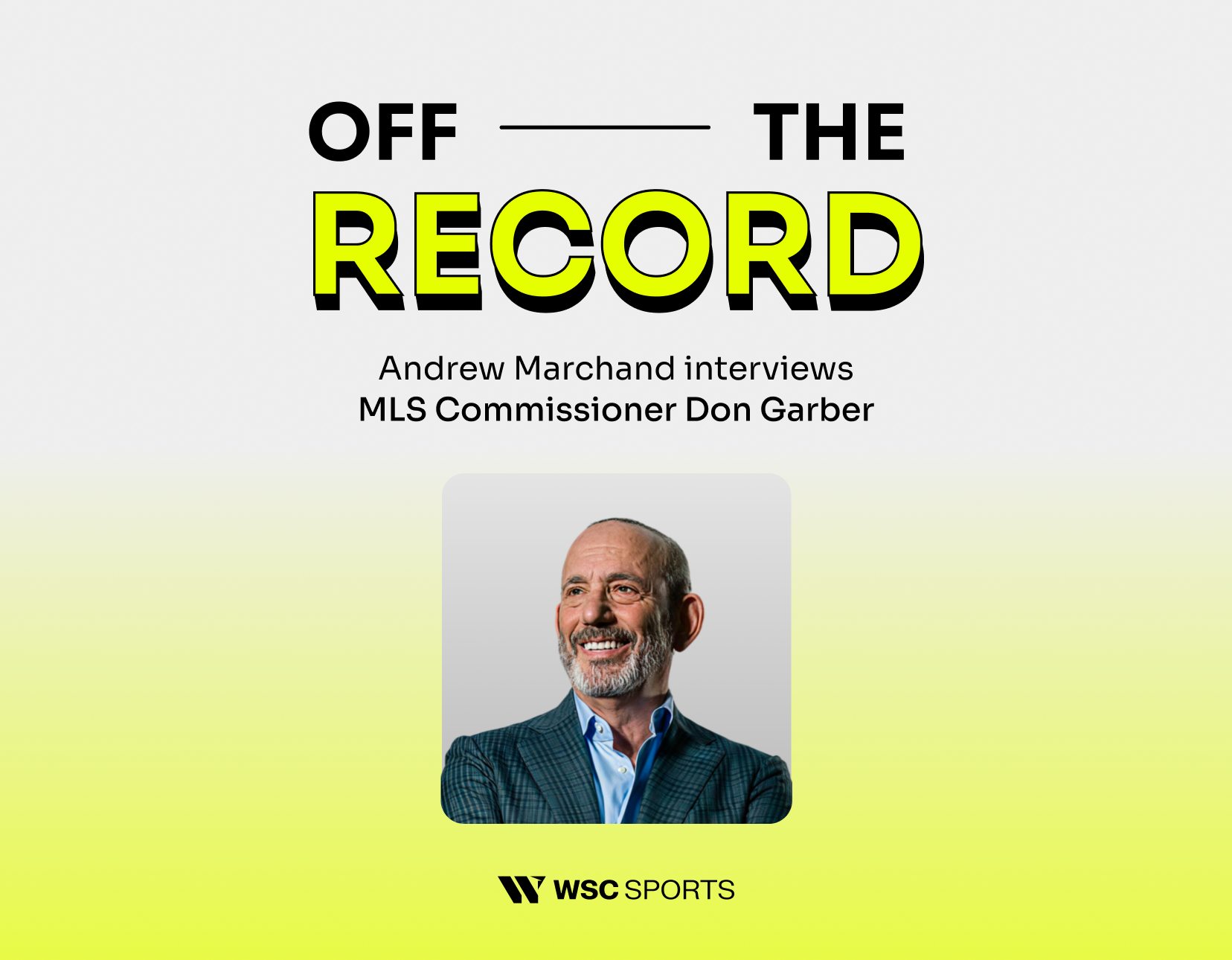


This is the first in a series of posts highlighting Off the Record, a WSC Sports interview series hosted by Andrew Marchand.
Don Garber has been the commissioner of Major League Soccer for nearly three decades, making him one of the longest-serving executives in American professional sports.
He took over MLS in 1999, when soccer was still a fringe sport in the American mainstream. Over the years, he’s overseen the signing of David Beckham and Lionel Messi, the construction of billion-dollar stadiums in major American cities, and a landmark streaming deal that moved all MLS games to Apple TV.
Garber sat down with sports journalist Andrew Marchand to reflect on how the 1994 World Cup created the conditions for everything that followed and what he hopes American soccer looks like once the world’s attention moves on.
Here are some of the highlights from the interview.
“No ‘94 World Cup, there’s no MLS”
What’s about to happen in 2026, with the World Cup returning to the US (along with Mexico and Canada) was set in motion over thirty years ago, when FIFA handed the US the tournament on one condition: build a real league.
“When America was granted the World Cup in ’94, there was no pro men’s league, certainly no pro women’s league. The sport was really fledgling. FIFA said, ‘We’ll give you the World Cup, but you have to commit to launching a division one men’s league.’ And US Soccer said, ‘Sure, we’ll do that.’
“No ‘94 World Cup, there’s no MLS. No MLS, there are no stadiums. There’s really not an American soccer culture. None of it existed in ’94 when the World Cup was here. None of it,” he said.
“David Beckham was the first step that said, this is going to be fine”
Before Lionel Messi, before the Apple deal and billion-dollar stadiums, there was one bet: that a global superstar would come here and people would care.
“We had to convince him [Beckham] that MLS was worthy. I remember having the press conference in LA and it was in the hot sun. He stayed in the sun and said hello to 3,000 people. How many athletes would do that today? How many athletes would go and lobby city council members all across Dade County for years trying to get that stadium done?”
“David was the first step that said, this is going to be fine. America is going to be a soccer nation and I’m going to help you get there. No David, there’s no Messi, but there’s 20 years in between that. 20 years of building stadiums, 20 years of getting the right media dynamic, 20 years of building a fan base. And it all started with him.”
“We’re blessed to have Messi in the league.”
At 39, playing 180 minutes in four days, selling out stadiums in Colorado and Salt Lake City, wearing the number one Adidas kit in the world.
“I was around when Michael Jordan was the big star. I was around when Wayne Gretzky was a big star. I remember listening to Muhammad Ali fights with a transistor radio under my pillow and to me he’s one of the greatest figures of our lifetime, if not all time.
“And I think that’s who Messi is. We’re blessed to have him in the league. I think it’ll be one of the marks and chapters in the American soccer book that will last forever.”
“The World Cup is not like any sporting event.”
Garber has attended World Cups throughout his career and draws on two specific memories to show how the World Cup is different from all other tournaments.
The first is from Qatar 2022, where he found himself watching Argentina play Saudi Arabia surrounded by Saudi fans. The second is from South Africa 2010, where he was in a stadium box with Bill Clinton, Mick Jagger, and New York Mayor Mike Bloomberg when Landon Donovan scored a last-minute goal to send the US through — a moment so overwhelming that a former president ignored protocol and pushed through the crowd to get to the locker room.
“I went to Qatar, I saw Saudi Arabia play Argentina. Somehow I was in the Saudi group and there were tens of thousands of Saudis, and when Saudi Arabia was beating Argentina, there was one older Argentinian guy in our group and the guy was crying, just beside himself. And when they scored, he was embraced by these Saudi guys. That’s not like any sporting event.
“When Landon Donovan scored a goal [for the US] in South Africa against Algeria, [former President, Bill] Clinton and his security just burst through the fans and went down to the locker room. It was the only time I’ve ever been in a locker room. I just can’t remember anything like that since.”
“I really do believe it’ll be bigger and better when the World Cup is gone.”
Garber is clear that he doesn’t expect the tournament to be a magic leap forward for MLS, with dramatically more fans and bigger TV numbers overnight. What he wants to see is a generation of new fans who came for the World Cup and stayed for the league. What he doesn’t want is a spectacular few weeks that leaves nothing behind.
“Do I think Major League Soccer is going to go from here to here because of the World Cup? I don’t. But I also don’t want it to be a Taylor Swift concert — a massive event that people attend and then move on from. The entire soccer industry, the women’s game, the men’s game, the minor leagues, the grassroots community, our federation, needs to be thinking about this. I really do believe it’ll be bigger and better and more valuable when the World Cup is gone.”
Watch the whole interview on YouTube.